How much time can an AI agent actually save a working team? According to the Pentagon's GenAI Task Force lead, one agent built with the Army's 101st Airborne Division cut a cyber workflow from 100 hours to 15. That is the headline number from a recent report on Army AI tools, and it comes with a lesson that applies well beyond the military: the tool worked because it was built where the work happens.
The same report describes a second, quieter use case. Army recruiters now have a chatbot, Staff Sgt. Star, that answers policy questions without a trip to the manuals or a senior colleague. Both stories are useful context for anyone watching how organizations fold AI agents into daily work — including the security worries that come with them.
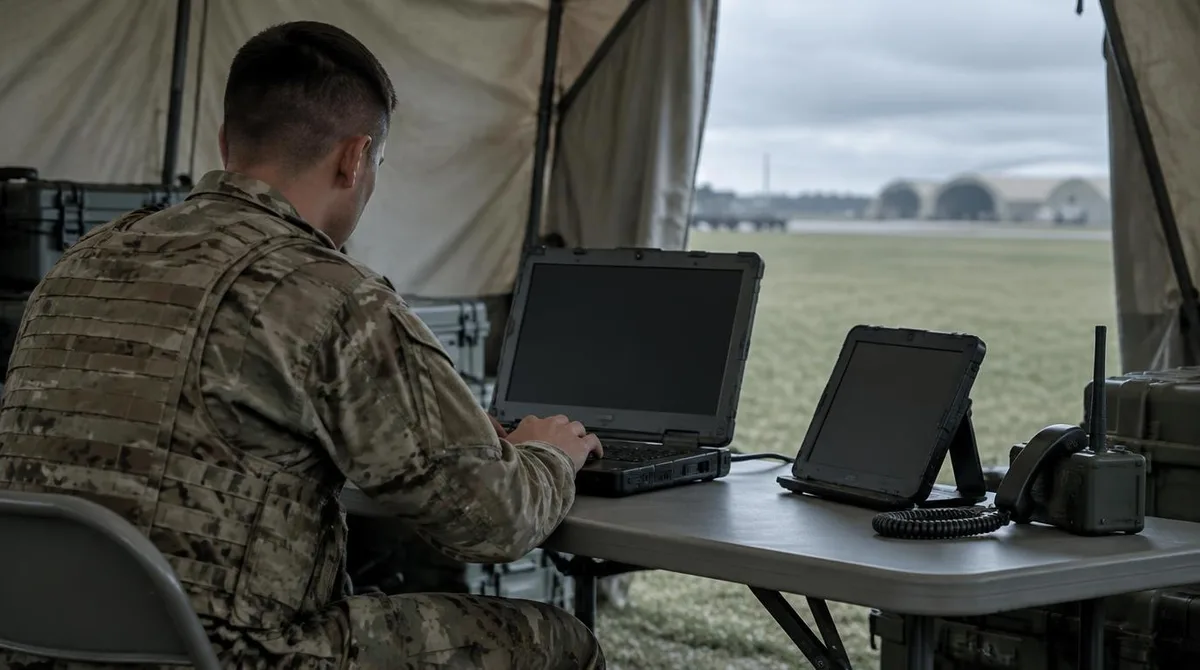
According to MeriTalk, Capt. Ryan Hetrick, the GenAI Task Force lead, described the effort at GovCIO Media & Research's AI Summit on Nov. 6 in Tysons, Va. His team built the cyber agent while working in a tent at Fort Campbell, Ky., alongside soldiers from the 101st Airborne. Then something smart happened: the cyber officers who had used it were enlisted to help spread its use across other units.
What is an AI agent, and why does the Army's approach matter?
An AI agent is software that carries out a task or workflow on your behalf, rather than just answering a single question. The Army's version of the idea is unusually practical. Hetrick said his task force embeds with units and builds tools using platforms including GenAI.mil, the Maven Smart System, and the War Data Platform.
The method matters more than any single tool. It pairs people who understand the mission with people who understand the technology, then relies on trained champions — the soldiers themselves — to bring the capability to other units. "You have to go where the warfighter is and understand their use cases and their mission," Hetrick said, per the report. We covered a connected angle in What the ChatGPT mobile app actually does, per its own release notes.
For civilian workplaces, that is a checklist worth borrowing. Build next to the people doing the work. Let early users teach the next wave. Don't ship a tool from a conference room and hope it sticks.
What did the Army's cyber agent actually do?
It compressed a cyber workflow from 100 hours to 15, according to Hetrick. That is an 85-hour saving on a single process — the kind of number that changes what a team can take on.
His team also built a Spot Report Agent for the White House's FIFA World Cup task force, working with personnel from the FBI, Coast Guard, and military. That tool cut a reporting process from about 20 minutes to 90 seconds. Hetrick said the point was not speed for its own sake: the saved time gave officials more room to coordinate responses to events on the ground.
He also had a message for defense contractors — the companies that supply the military's technology. Work directly with military users, he urged, to achieve and expand AI-enabled workflow gains. Translation for any vendor: sitting in a demo booth is not the same as standing next to the desk where the work gets done.
How does the Army recruiter chatbot work?
Staff Sgt. Star is a chatbot built for Army recruiters, developed in less than three months, according to Mark Rodriguez, an infrastructure IT specialist with the Army. It draws on a curated knowledge base of approved Army business processes and system guidance — which is a careful way of saying it answers from vetted material, not from the open internet.
The problem it solves is familiar to anyone in a rules-heavy job. Recruiters handle applicants with varied backgrounds, and the report notes that training alone cannot cover every gap. A recruiter can ask the chatbot which waiver an applicant needs or how to process it, Rodriguez said. Readers following this should also see Apple mail ai features — Apple Mail and Notes: Which AI features actually ship, and what they cost.
The knock-on effects are the interesting part. Chatbot assistance reduces demands on senior recruiters and station commanders. And by helping users tell the difference between a process question and an actual system malfunction, the chatbot can cut down on unnecessary help desk tickets — freeing technical teams to improve the systems themselves.
What is the catch? AI can create insights more sensitive than its inputs
Here is where the story turns, and it is the part most organizations miss. Garrett Lee, regional vice president of public sector sales for Broadcom's Enterprise Security Group, warned that combining information quickly creates security risks — especially when AI draws conclusions that exist in no single source document.
Lee offered a hypothetical military logistics example. Give an AI system access to maintenance schedules, supply chain information, equipment readiness data, and deployment information. Each dataset is individually controlled and protected. But ask which units are most likely to face readiness challenges over the next 60 days, and the system can combine those sources into an assessment of operational vulnerabilities.
"No single document contained that assessment. The AI created it through inference," Lee said, per the report. His conclusion: organizations must consider the sensitivity of what AI can derive, not just what it receives. "In the AI era, we must also protect the information we produce, including insights we don't even know our data could reveal."
Brandon Dixon, co-founder and chief technology officer of endpoint security company Ent, added a second wrinkle: you need to understand how people and agents use information inside specific workflows. Simply identifying sensitive data and approving applications gives you only part of the picture.
His example came from a hospitality company. Human resources employees uploaded sensitive records through WhatsApp after the app added Meta AI. The employees were using an approved communications tool — but they exposed information through an AI capability the company had never approved. Dixon's takeaway: security controls need to sit close enough to the work to interrupt risky actions as they happen.
What should a newcomer take from this?
Three things. First, the biggest AI wins in the report came from embedding with users, not from buying a platform and hoping. Second, a curated knowledge base — like the one behind Staff Sgt. Star — is a simple, concrete way to keep a chatbot grounded in approved guidance. Third, the security question has changed shape. The risk is no longer only who can see your data. It is what conclusions your AI can build from data that is safe on its own.
The report leaves some things unstated. We do not know which specific cyber workflow was compressed, how the 100-to-15-hour figure was measured, or how widely Staff Sgt. Star has rolled out. Those are the details to watch as the Army's approach spreads to other units — and, if the contractors listen, to the tools the rest of us use at our desks.