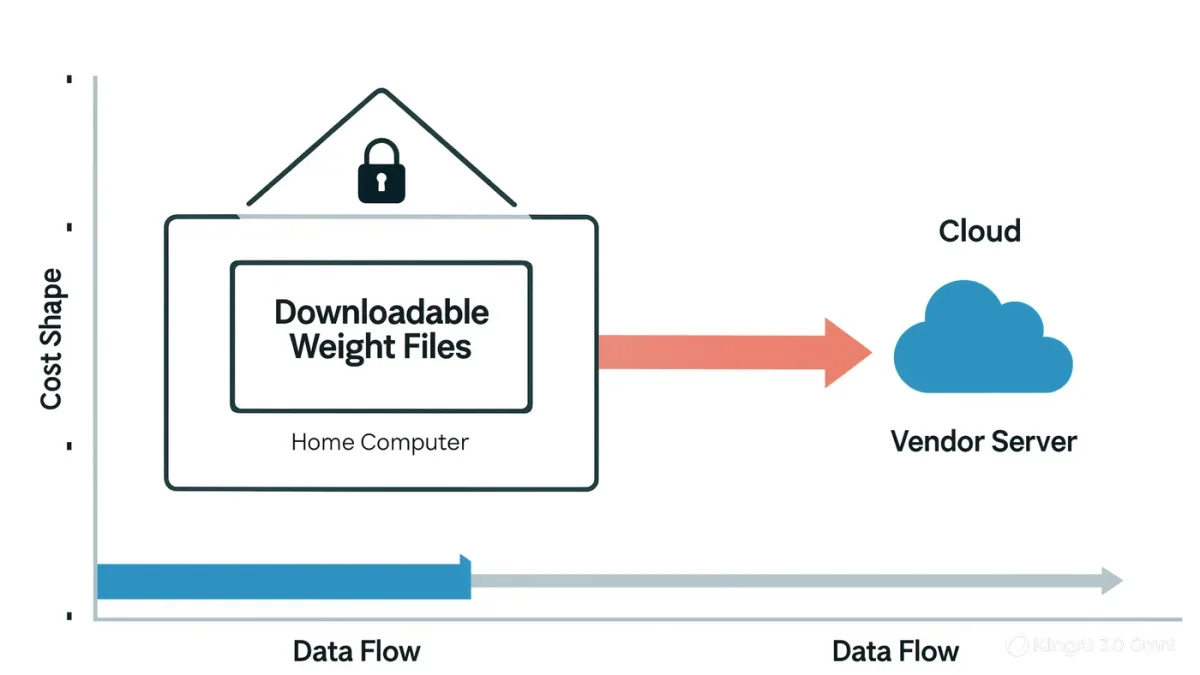
An open-weight model is one whose trained parameters — the files that make the model work — are published for anyone to download and run on their own hardware, while a closed model keeps its weights on the vendor's servers and serves answers through an API or app, per the release terms of open-weight families like Meta's Llama and Mistral's open releases versus the documented setup of OpenAI's or Anthropic's products. The practical consequence is a data bargain: with open weights, your prompts can stay entirely on your machine; with closed models, every prompt travels to the vendor. That single difference drives most of the real-world choosing between them — more than capability, which shifts with every release cycle.
RechargeMe publishes information, not advice. Licensing terms for open-weight models vary per release and are the controlling documents; read them, not the word "open."
What exactly is being opened?
Not the training data, and usually not the training code — the weights. A weight file plus a way to run it gives you a working model: no vendor account, no per-token billing, no telemetry you didn't install yourself. But most open-weight releases carry licenses with conditions. Meta's Llama licenses, as published with each release, grant broad use with thresholds and acceptance terms; other families use variants of open-source-style licenses with AI-specific clauses. "Open weights" describes distribution, not freedom: the license decides what you may build, at what scale, and for whom. The Open Source Initiative has publicly argued that most of these licenses do not meet open-source criteria — a useful reminder that the vocabulary is contested.
What do you gain running weights yourself?
Three documented advantages. Data control: prompts and context never leave infrastructure you control, which is why regulated industries and privacy-sensitive teams are the natural constituency. Cost shape: no per-token fees — you pay in hardware or rental compute, which at high volume can undercut API pricing, though the breakeven depends entirely on your usage. And pinning: a downloaded model version does not change until you replace it, unlike API defaults that vendors silently retire and swap, per their published deprecation policies. For reproducible workflows — a legal summarizer whose behavior must not drift mid-case — pinning is sometimes the entire argument.
What do you give up?
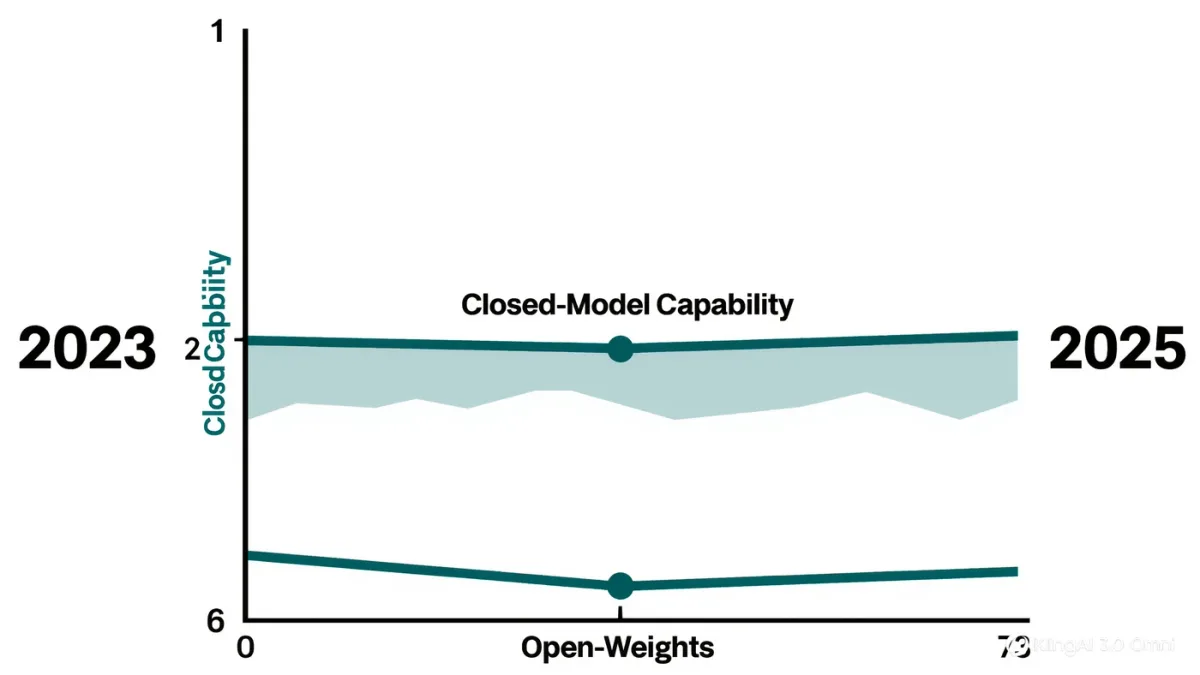
Convenience and, at the top end, capability. The largest closed models have consistently occupied the leading tier of published benchmarks, with the strongest open-weight releases following at a distance that narrows and re-widens with each cycle — trackable in each release's model card and independent leaderboards. Running weights yourself also means owning the ops: quantizing models to fit memory, keeping inference software updated, and accepting that a laptop-class machine runs laptop-class models comfortably and frontier-class models not at all. Vendor APIs package all of that away, which is precisely what the per-token fee buys.
| Dimension | Open weights | Closed API |
|---|---|---|
| Prompts stay local | Yes, if run locally | No — sent to vendor |
| Cost model | Hardware/rental, no per-token | Per-token, zero setup |
| Version pinning | Exact, until you change it | Vendor deprecates on schedule |
| Top-end capability | Trailing, closing at times | Usually leading tier |
| Operational burden | Yours | Vendor's |
What about the small-model twist?
The gap between "runs on a phone" and "needs a datacenter" has become the most active front. Distilled and small open-weight models now handle summarization, drafting, and classification well on consumer hardware, per their published evaluations, and vendors on both sides have shipped small fast tiers — a convergence covered steadily by technology desks such as Bloomberg's. For many everyday tasks, the capability question has stopped being "open versus closed" and become "small and local versus large and remote," which is a different, and often easier, trade.
How do you actually choose?
By constraint, in this order. Legal or policy constraint on data leaving your infrastructure: open weights, or an enterprise contract with a closed vendor that documents no-training and processing terms — both paths exist, with different costs. High, steady volume: run the arithmetic on self-hosted versus API at your token counts. Everyone else: the strongest tool for the job this quarter, which for now usually means a closed API for frontier tasks and open or small models for bulk routine work — a hybrid that most serious teams have converged on without anyone decreeing it.
What the debate doesn't settle
Safety arguments cut both ways and resolve nothing for a chooser: open weights can be misused by anyone and audited by everyone; closed models can be governed by their vendors and weaponized by their terms. Those are policy questions. For the desk-level decision, the controlling facts are the license text, the model card's stated capabilities and limits, and where your data is allowed to travel — all three of which are documents, not vibes.
FAQ
- Is an open-weight model free? The weights usually are to download; the costs move to hardware, electricity, and your time. Licenses may still restrict commercial use at scale — read the specific release's terms.
- Are open-weight models worse than ChatGPT-class tools? At the frontier, generally a step behind per current evaluations; for routine summarizing and drafting, strong small open models are often sufficient on a good laptop.
- Which is better for private data? Locally run open weights keep prompts on your machine by construction; closed vendors offer enterprise no-processing terms instead. Both are documented paths — pick by cost and auditability, not slogans.