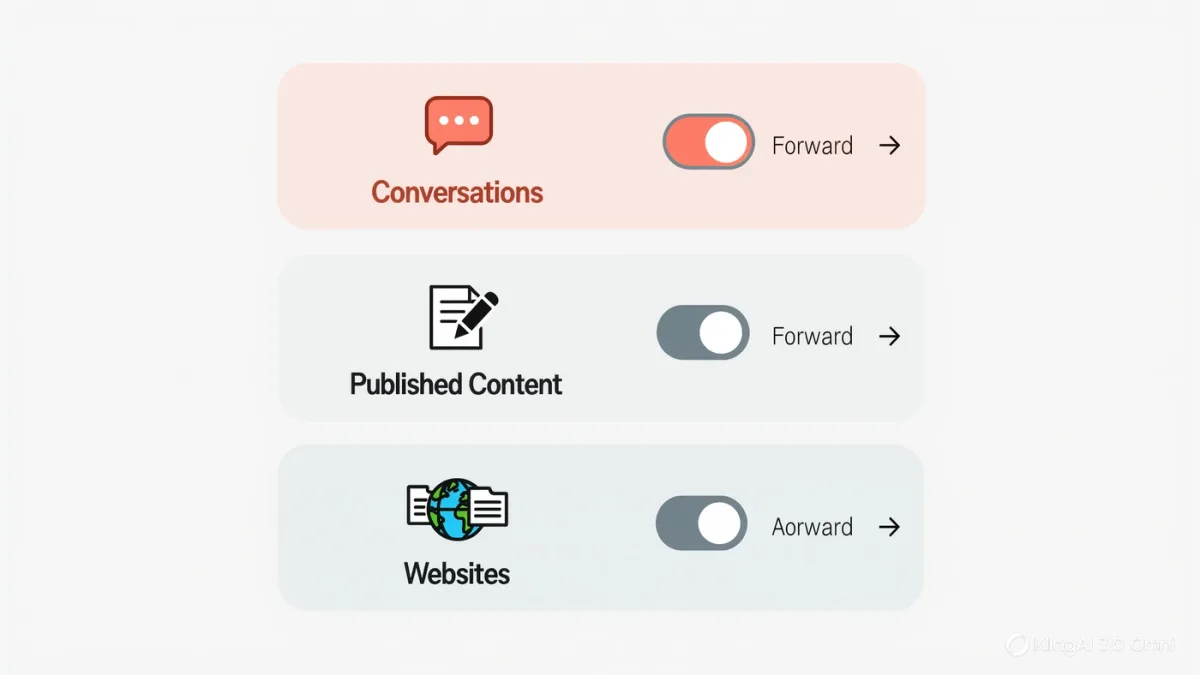
The documented training opt-out landscape has three layers with different tools: chat-product settings — the consumer toggles OpenAI, Anthropic, and Google each publish for keeping your conversations out of model training; creator and platform controls — the mechanisms for opting content you publish out of AI licensing or scraping; and site-owner declarations — the robots.txt and emerging AI-specific signals that tell crawlers what they may harvest. Each layer controls only its own slice, none is retroactive, and all of them shift under vendor policy edits — so the durable practice is knowing which layer you're standing on, finding the current switch, and recording that you flipped it.
Details below follow the vendors' published policies and help documentation as of early 2026; policy text is the controlling document and changes without notice.
What do the chat-product opt-outs document?
A consistent pattern with inconsistent defaults. OpenAI's help documentation describes a data-control setting that excludes your conversations from training, plus enterprise no-training terms on business tiers; Anthropic's consumer policies describe a similar opt-out for improving models, with stronger commitments on API and commercial usage; Google's AI offerings tie activity settings to training use for consumer accounts, with Workspace terms carving customer content out. Two documented cautions: the opt-out's location and naming migrate with product redesigns — re-verify after major releases, since new features have historically launched defaulted-in; and opt-outs are forward-looking only — conversations already used are not un-trained, which is the physics of the situation, not a policy choice.
What about content you publish?
The creator layer, most active through 2024-2026 as licensing deals reshaped it. Platform-level settings: major social and publishing platforms have introduced AI-licensing toggles or signed data deals whose terms your content follows — the documented cases include platforms letting you opt out of third-party AI training while reserving their own use, terms that shifted with ownership changes, and settings whose defaults favored training. Independent publishing: site owners can signal crawler permissions via robots.txt and the emerging AI-specific standards (the document-signaling proposals vendors have documented support for), which ask — rather than compel — well-behaved crawlers to comply. The honest limit, documented by the enforcement gap: signals bind the polite, and the legal force of opt-outs varies by jurisdiction and remains contested in the litigation over training data that courts were still working through in 2025-2026.
| Layer | Tool | Controls | Limit |
|---|---|---|---|
| Chat products | Vendor data settings | Your conversations' training use | Forward-looking; settings migrate |
| Published content | Platform toggles, licensing terms | Platform-mediated use | Defaults favor training; terms shift |
| Websites you own | robots.txt, AI signals | Crawler access requests | Voluntary for crawlers |
| Everything | Regulation (GDPR etc.) | Legal rights, where applicable | Enforcement uneven, law evolving |
Does any of this protect sensitive material?
Partially, which is why the standing advice in this series has always outranked the settings: the opt-out controls training use, not processing — your prompt still crosses the vendor's servers, retained per its retention policy, even with training excluded. For genuinely sensitive material, the documented strong options are enterprise tiers with contractual no-processing terms, or local models where the data never leaves the machine. The consumer opt-out is a meaningful privacy improvement and not a confidentiality mechanism; treating it as one is the category error that turns a settings toggle into a compliance strategy.
What did the legal landscape settle?
Little, honestly. The copyright questions at the heart of training data — whether ingesting copyrighted works to train models is fair use, what an opt-out is worth — were the subject of major litigation between creators, publishers, and AI companies still unresolved through 2025-2026, with settlements, licensing deals, and rulings arriving piecemeal. Europe's GDPR gave individuals training-related rights with real but unevenly enforced effect; other jurisdictions were legislating in parallel. The practical posture for a person or small publisher: use every documented opt-out at your layer, understand them as requests and settings rather than guarantees, and watch the coverage — outlets including Reuters and the BBC have tracked the litigation and the licensing deals steadily, which is where the durable answers will eventually land.
What's the practical checklist?
Thirty minutes, once per vendor. Chat products: find the current data-control setting on every AI account you hold, disable training contribution, screenshot the setting with its date — the screenshot is for re-checking after redesigns. Published content: audit your platforms' AI-licensing settings and defaults, opt out where the terms allow, and note that platform terms follow the platform, not you. Owned sites: declare crawler permissions with robots.txt and the AI-specific signals, accepting their voluntary nature. And re-run the audit whenever a vendor ships a major release — the documented pattern of new features arriving defaulted-in is the reason this is a recurring calendar item rather than a one-time chore.
FAQ
- Does turning off training use stop the company seeing my chats? No — it excludes conversations from model improvement; prompts still process on their servers under retention policies. Confidential material needs enterprise terms or local models.
- Can I opt out retroactively? Not in any documented mechanism — opt-outs are forward-looking; already-used conversations aren't un-trained.
- Do robots.txt blocks stop AI crawlers? For well-behaved crawlers that honor them, yes; the signals are requests, not walls — enforcement against non-compliant crawlers is a separate legal question.