Walk into any hardware store and you will meet a wall of unfamiliar names: adjustable wrench, torpedo level, combination square. The good news is that a beginner only needs to know about a dozen tools to handle most small repairs, and each name points to one clear job. Once you can match the name to the task, shopping stops being guesswork and repair videos start making sense.
This glossary does exactly that. It groups the essential hand tools by what they do — measuring, cutting, gripping, striking, and fastening — and explains each one in a sentence or two. Nothing here requires prior experience, and none of it requires power tools.
Even the word "essential" earns its place. According to the Cambridge Dictionary, essentials are the basic things something cannot do without — and that is the standard applied to every tool below. If a tool did not earn a spot by doing a job nothing else covers, it stayed off the list.
Which tools measure and mark?
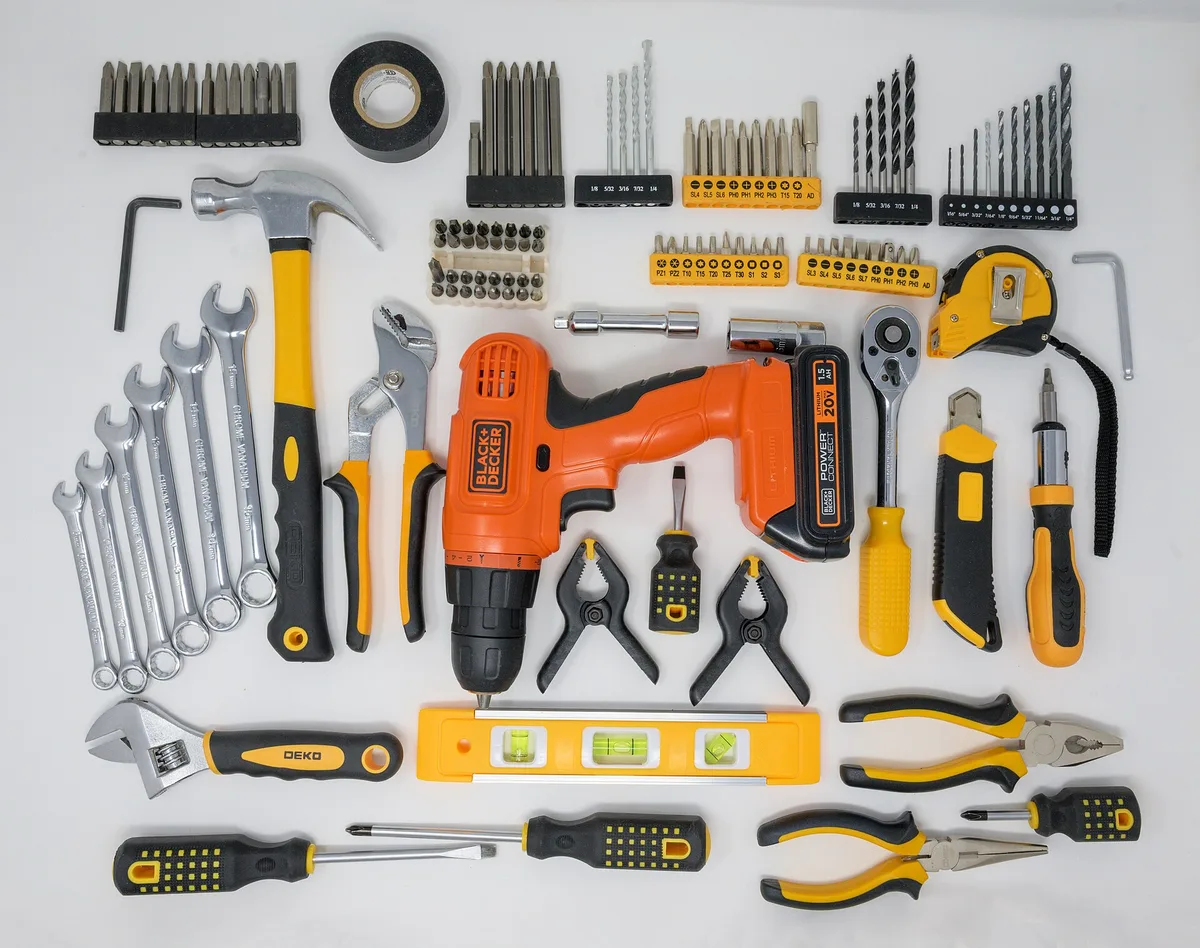
Measuring tools come first because almost every other job depends on them. A tape measure is the flexible ribbon in a metal case; it measures lengths and distances, and it is the single most-used tool in most kits. A combination square is the flat metal ruler with a sliding head; it checks whether two surfaces meet at a right angle and scribes straight lines for cuts.
A level tells you whether a surface is horizontal (level) or vertical (plumb), using a bubble in liquid. Small pocket-sized versions are called torpedo levels. A pencil sounds too obvious to list, but marking where a cut or hole goes is a real step, and carpenters treat it as a tool in its own right. We covered a connected angle in Which Claude tier for which work? A decision guide from Anthropic's own pricing page.
The practical habit: measure twice, mark once, then cut. It costs nothing and prevents most beginner mistakes.
Which tools cut?
A utility knife is the small razor-bladed knife with a retractable or snap-off blade. It cuts cardboard, opens packaging, scores drywall, and trims carpet edge. Blades are cheap and replaceable, so a dull blade is never an excuse.
Scissors and tin snips cover different materials. Household scissors handle paper and light fabric; tin snips are the strong scissor-like cutters for sheet metal and plastic. A hacksaw is the fine-toothed saw in a C-shaped frame, and its job is cutting metal — bolts, pipes, and thin bar stock.
For wood, a handsaw is the classic long-bladed saw with a wooden or plastic grip. It cuts boards to length across the grain. Beginners should let the saw's own weight do the cutting; forcing it is how straight lines turn into wavy ones.
Which tools grip and turn?
This is the group beginners most often confuse, so the distinctions matter. A screwdriver turns screws. The two common tips are flat (a flat blade for slotted screws) and Phillips (a cross-shaped tip for cross-recessed screws). A small set with both types covers most household screws.
A wrench, also called a spanner, grips nuts and bolt heads. A combination wrench has an open end and a closed ring end. An adjustable wrench has a movable jaw, so one tool fits many sizes — convenient, though a fixed-size wrench grips more securely. Pliers are the pincer-like tool with two pivoting arms; they grip, bend, and pull. Needle-nose pliers have long thin jaws for reaching into tight spots, and locking pliers clamp shut and stay shut.
One warning worth its own sentence: a wrench that does not quite fit will round off the nut's corners, and then nothing fits. Use the size that matches.
Which tools strike and pry?
A claw hammer is the everyday hammer: one face drives nails, and the curved claw on the back pulls them out. That dual job makes it the default hammer for most households. Choose one you can swing comfortably; weight matters more than looks.
A mallet has a soft head — rubber, wood, or plastic — and its job is striking without damaging the surface. It is the tool for tapping floorboards into place or seating a joint without leaving dents.
A flat pry bar (sometimes called a flat bar) is the flat metal lever that pulls trim, lifts nails, and separates joined pieces. It multiplies your pulling force, which is why it succeeds where fingers fail.
Which tools fasten and hold?
Screws, nails, and anchors are the fasteners themselves. Screws hold by threading into material and can be removed; nails hold by friction and are faster; anchors let a screw grip hollow drywall where wood is not there to hold it.
A cordless drill technically edges into power-tool territory, but it earns its place because driving a hundred screws by hand is misery. Its job is boring holes and driving fasteners, and a clutch setting prevents overdriving screws into soft material.
Clamps are the third hand every beginner discovers late. A bar clamp or C-clamp holds two pieces together while glue dries or while you work. Nothing in the kit replaces holding power, so buy at least two.
Once the tools start to multiply, storage becomes the next decision. We compared the main options — a rolling chest, a wall system, and a soft bag — in our guide to tool storage systems ranked: chest, wall, and bag.
What this means for your first purchase
Our analysis of the list above is simple: a beginner's kit is about twelve tools, and almost none of them are expensive. The measuring group (tape measure, square, level), one hammer, one mallet, a screwdriver set, a small wrench set, pliers, a utility knife, a handsaw, and two clamps will carry you through furniture assembly, hanging shelves, basic repairs, and most flat-pack disasters.
Buy quality where the tool takes impact — hammer, screwdrivers, pliers — and save on items like clamps, where even budget versions hold. Skip the giant boxed sets; they pad the count with duplicates you will never reach for.
What the list does not settle is brand choice or exact prices, because those shift constantly and vary by region. What it does settle is vocabulary. The next time a repair video says "grab your combination square and score the line," you will already be holding it — and that is the whole point of knowing the names.