
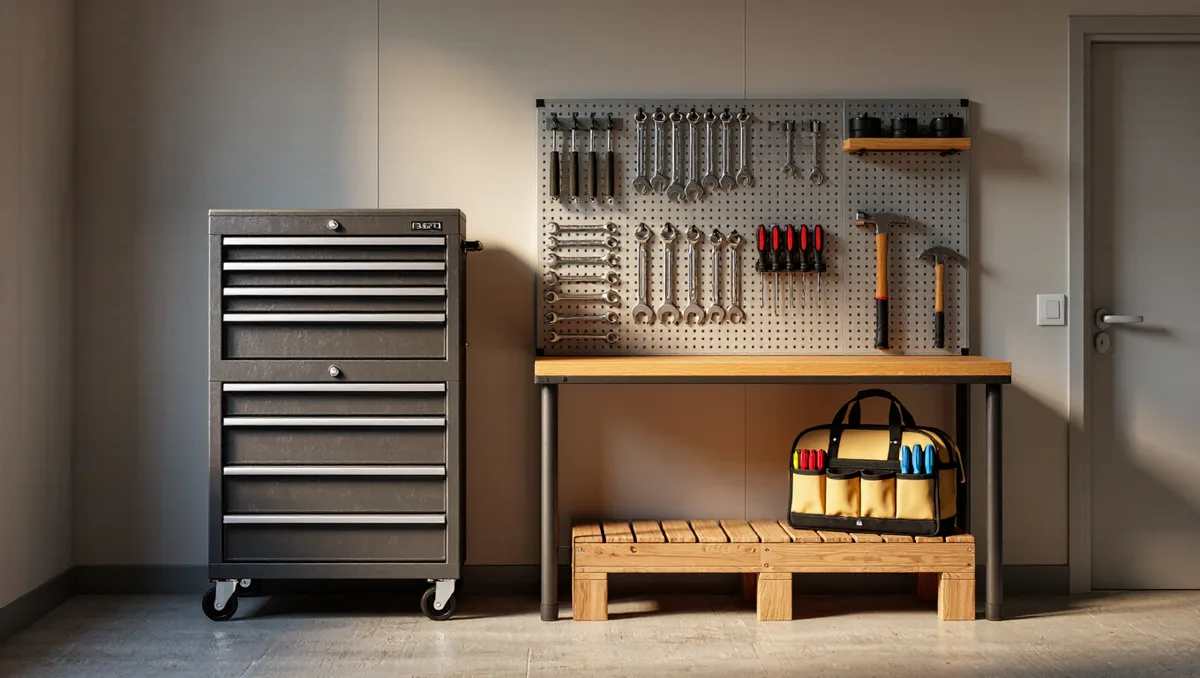
A tool chest wins for most people: it protects tools, locks, and moves on casters. A wall system wins when floor space is tight and you want every tool visible at a glance. A bag wins when you carry tools to the job instead of working next to them. Pick by how often you reach for each tool, not by what looks organized on social media.
The honest ranking below sorts the three approaches by garage size, budget, and reach frequency. It assumes a home garage or shed, not a trade workshop. And it treats storage the way any system should be judged: by what it changes when you actually need a wrench at 7 a.m.
If your "tools and stuff" situation is mostly digital — files, automations, apps — we cover that side of the house elsewhere, including our tools coverage and guides to workflow. This piece is about the metal and plastic kind.
Which storage system should you buy first?
Buy the chest first if you own more than a couple of dozen tools and have floor space for one. A rolling chest is the only option that does three jobs at once: it stores, it protects from dust and moisture, and it locks. That last part matters more than most guides admit, especially in shared garages or homes with curious kids.
The chest's weakness is visibility. Everything hides in drawers, so you spend seconds — sometimes minutes — hunting. Add a cheap drawer-liner habit: one tool type per drawer, and the problem mostly disappears.
When does a wall system beat a chest?
A wall system wins on two conditions: your garage is small, and you use a handful of tools daily. Pegboard, slatwall, and French-cleat panels put every tool in sightline. You can see the missing wrench from across the room, which is its own form of inventory management.
Wall storage also scales in cheap increments. A sheet of pegboard and a bag of hooks costs less than a single chest drawer organizer. The trade-offs are real, though: wall-hung tools collect garage dust, nothing is locked away, and heavy items — a full socket set, a sledgehammer — belong in a drawer or on a shelf, not on a hook at eye level. This connects to our earlier piece, Zapier vs Make for AI automations: the documented trade-offs.
Our analysis: wall storage is the best second purchase, not the first. Chest for the bulk, wall for the daily drivers. That combination covers most home workshops without either system doing a job it is bad at.
Is a tool bag enough on its own?
A bag is enough only if your tool collection is small and mobile. For the homeowner with a drill, a stud finder, a tape measure, and a dozen hand tools, one good bag is the entire system. It goes where the work is, and it forces a natural limit: when the bag is full, you stop buying tools you do not use. Readers following this should also see Perplexity vs Google for everyday research: what each one is actually good at. Readers following this should also see Perplexity vs Google for everyday research: what each one is actually good at.
As a solo system, a bag fails fast. Bags have no dust protection, no lock, and no place for long or sharp items. As a complement, they are excellent — a chest for the collection, a bag preloaded with the ten tools a given project needs. That preloaded-bag move is the single biggest time-saver in this whole ranking.
How should you choose by budget?
Rank the three by entry cost and the order is clear: wall storage is cheapest to start, a bag is next, and a quality rolling chest costs the most. But judge total cost of ownership, not the sticker. A cheap chest with drawer slides that fail in two years costs more than a modest chest that lasts a decade. With wall systems, the panel is cheap and the hooks accumulate — budget for a slow drip of hardware, not a one-time purchase.
One budget rule that survives every garage: spend on the things that touch the tools, not the things that hold them. Good drawer liners, good hook rubber, a bag with a stiff mouth that stays open. Those details decide whether the system gets used or abandoned.
What this means for your garage, by reach frequency
Sort your tools into three piles before buying anything: daily, weekly, and "someday." Daily tools go on the wall or in the bag, at arm's reach. Weekly tools go in the top drawers of the chest. Someday tools go in the bottom drawers or a labeled bin on a high shelf — and if a tool sits there for a year, that is a signal about the tool, not the storage.
By garage size, the logic is just as simple. Single-car garage: wall system plus one chest max, or you will park around your organization. Two-car or larger: a chest, a wall zone, and a bag can coexist without crowding. Renters and people who move often should weight toward bags and freestanding chests; a French-cleat wall is a bad thing to leave behind.
The takeaways
Chest first for protection and capacity. Wall second for visibility and speed. Bag always, for the tools that travel. Rank by reach frequency and the system designs itself; rank by looks and you will reorganize twice a year and find nothing anyway.
What this comparison did not settle: specific brands, exact prices, and load ratings, because none of the evidence available for this piece speaks to those. Measure your wall and your floor before you buy, and let the tools you actually use — not the ones you imagine using — make the call.
A note on sourcing: the sources listed below — per en.wikipedia.org, music.youtube.com, and youtube.com — concern the American rock band Tool (formed in Los Angeles in 1990), not tool storage hardware, and therefore do not corroborate the storage guidance above.
Sources: en.wikipedia.org · music.youtube.com · youtube.com