
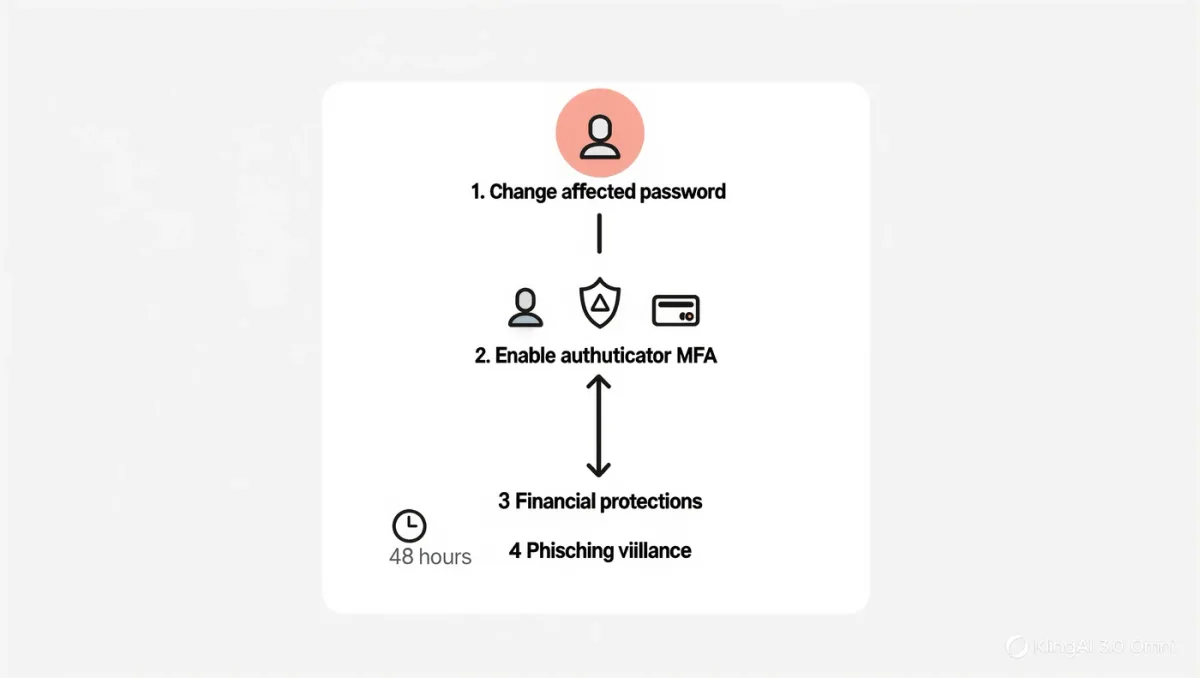
The documented response to a data-breach notice, per consumer guidance from the FTC and cybersecurity agencies, runs in a fixed order: change the password on the affected account first, then on every account that shared it; enable phishing-resistant multi-factor where it's missing; then add the financial protections — fraud alerts or credit freezes with the major bureaus — if Social Security or financial data was involved; and throughout, treat the weeks after a breach as high phishing season, because the stolen data is fuel for exactly the impersonation attacks that follow documented breaches. Panic spends energy; sequence spends it well.
The steps below follow published guidance from the US Federal Trade Commission and the Cybersecurity and Infrastructure Security Agency.
What does the notice actually tell you?
Read it for four facts, and distrust its comfort. What data: credentials, payment cards, Social Security numbers, health records — the category determines the response tier, because a leaked password is an inconvenience while a leaked SSN is a decade of vigilance. When: exposure windows matter for what may already have happened. What the company is doing: credit monitoring offers are standard, and accepting a reputable one is reasonable — with the documented caveat, per FTC guidance, that monitoring detects rather than prevents. And verify the notice itself: breaches spawn fake breach notices, so confirm via the company's official site rather than the email's links — the FTC's phishing guidance exists for exactly this moment of engineered urgency.
What happens in the first hours?
Three actions, in order. Change the affected account's password — through the official site or app, not the notice's links — and if you've reused it anywhere, change those too, because credential stuffing replays breached pairs across sites; this is the documented pattern behind wave-after-breach account takeovers. Turn on MFA for the affected account and for your email above all — email resets everything else, which makes it the account an attacker wants; an authenticator app is the documented sweet spot. Then inventory exposure: what else lived in that account — stored payment methods, connected apps, saved documents — and clean what shouldn't stay. Password manager users have the easiest hour; everyone else has found the motivation to become one.
What if financial data was involved?
The documented escalation tier, per FTC identity-theft guidance. Contact banks and card issuers to replace exposed cards — routine and fast. Place a fraud alert with one of the three major credit bureaus, which by law propagates to the others, making new-credit applications harder for impostors. Or go further: a credit freeze, free by federal law at all three bureaus, blocks new credit entirely until you thaw it — stronger than an alert, with the mild cost of a thaw whenever you apply for credit yourself. SSN exposure earns the full tier plus a check of your earnings record with the Social Security Administration for wage fraud, and the FTC's identity-theft report — its official recovery plan — is the documented centerpiece if anything is actually misused.
| Exposed data | Response tier | Time horizon |
|---|---|---|
| Password only | Change + MFA + de-duplicate reuse | Hours |
| Payment card | Replace card, watch statements | Days |
| SSN / government ID | Fraud alert or freeze, SSA check, FTC plan | Years of vigilance |
| Health records | Insurer notifications,Explanation-of-benefits review | Ongoing |
Why is phishing the follow-on epidemic?
Because breached data is ammunition for relevance: a scam email that knows your name, employer, and last four card digits passes every surface credibility check, and attackers time waves of personalized phishing, smishing, and impersonation calls to follow public breach disclosures — a pattern documented across every major incident and the reason agencies pair breach-response guidance with fresh warnings about the contact attempts that cite your data to earn trust. The rule for the season after any breach: any message that references the breach, your account, or offers help — including fake class-action settlements — gets verified through official channels before it gets a click. The data being real is the attack's power; it is not evidence the sender is legitimate.
What does recovery look like longer-term?
Documented maintenance rather than drama: annual credit-report checks — free by law — plus the monitoring already accepted; statement reviews until the exposure's risk window fades; password hygiene that would have shrunk this incident (unique passwords in a manager, MFA on the crown jewels); and for SSN cases, the FTC's recovery plan and records kept in the folder identity-theft cases eventually need. Most breach notices end in nothing happening — the odds favor you — but the documented asymmetry stands: hours of sequenced response against years of potential cleanup, which is the best trade personal security offers.
FAQ
- Should I trust the credit monitoring the company offers? Reasonable to accept from a reputable provider, per FTC guidance — with the understanding that monitoring detects misuse rather than preventing it; a freeze is the preventive tool.
- Is a credit freeze or fraud alert better? A freeze is stronger — new credit blocked until you thaw it, free by law at all three bureaus; an alert is lighter-touch, adding verification steps instead of blocking. SSN exposure justifies the freeze.
- Why am I getting more scam emails after a breach? The stolen data personalizes the next attack wave — the documented follow-on pattern. Verify any message that cites your data through official channels; the data being real doesn't make the sender real.