
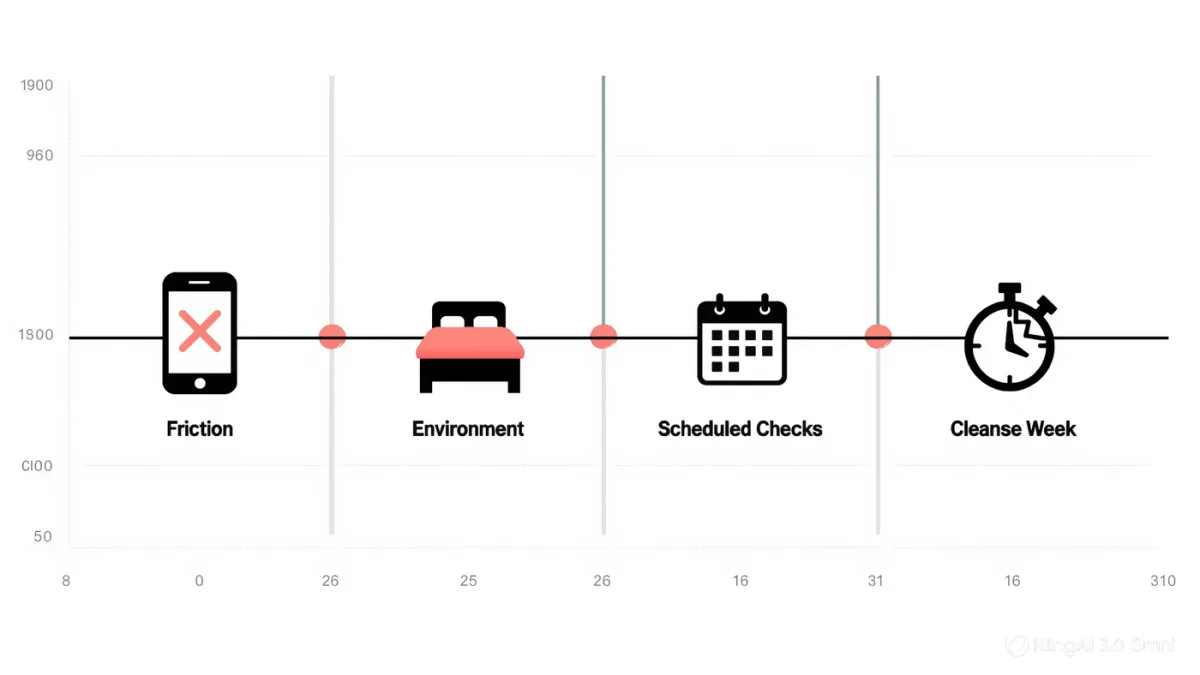
The documented evidence on digital detox interventions — abstinence periods from screens or specific apps — is modestly positive and consistently conditional: reviews of screen-abstinence and social-media-reduction studies find short-term improvements in mood, attention, and sleep for some participants, with effects that fade when the abstinence ends and the environment resumes, and the strongest results attached not to total cleanses but to targeted reductions of the specific apps driving compulsion. The practices that hold, per that literature plus the clinical guidance on behavior change, are structural: boundaries that persist after the willpower does. The dramatic week in the woods is a story; the phone outside the bedroom is a result.
RechargeMe publishes information about research, not medical or mental-health advice. Studies are characterized per their published findings; persistent distress deserves a clinician, not a detox.
What does the detox research actually show?
Three honest findings from the growing experimental literature on social-media abstinence and reduction — including well-cited studies where participants abstained or cut use for weeks and reported outcomes. First, effects exist: abstinence periods are associated with improvements in mood, loneliness, and sleep in several studies, particularly among heavier users. Second, effects are modest and mixed: not every study finds them, magnitudes are small against the noise of life, and the comparison conditions matter — a detox from doomscrolling differs from a detox from video calls with grandchildren. Third, rebound is the norm: abstinence ends, habits reassert, because the environment — the apps, the defaults, the norms — outlives the cleanse. The literature's quiet conclusion mirrors every behavior-change field: change the defaults or re-change nothing.
Which practices have documented staying power?
The structural tier, each with a mechanism the literature recognizes. Friction changes: logging out, deleting apps from the phone (the web version remains for deliberate use), grayscale screens — documented in attention research as increasing the effort of the habitual path. Environmental boundaries: the phone charging outside the bedroom, meal-times device-free — physical arrangement beats resolution because it operates nightly without a decision. Scheduled windows: checking specific apps at set times rather than continuously — the batching principle applied to feeds, converting constant availability into discrete episodes. And replacement, the most underrated: the documented finding that abstinence works best when the displaced time has somewhere to go — the walk, the person, the book already waiting — because a vacuum refills with the old habit by default.
| Practice | Mechanism | Documented staying power |
|---|---|---|
| App off the phone | Friction on the habitual path | High — survives willpower |
| Phone out of bedroom | Environment, nightly | High — one decision, repeated by furniture |
| Scheduled check windows | Batching availability | Medium — needs a calendar habit |
| Total cleanse week | Abstinence spike | Low — rebound is the documented norm |
What about AI tools — detox for assistants?
The detox literature predates conversational AI, so honesty first: no studies examine abstaining from chatbots. What transfers is the mechanism inventory, applied to the usage patterns this series has documented. If assistants have become ambient — always open, consulted reflexively — the structural tier applies: assistant sessions scheduled rather than continuous, the tool closed between them, capture lists intercepting the reflexive query. If the compulsion is productivity-flavored — the assistant enabling ever-more output at ever-oddler hours — the boundary is temporal, the after-hours structure covered earlier. And if use is deliberate and bounded — sessions that begin and end — there may be nothing to detox, a possibility the discourse rarely allows: the question is always what the use displaces, never the tool's mere presence.
Why do dramatic detoxes fail — and still get prescribed?
They fail because they're designed to: a cleanse is a suspension of the environment, not a change to it, and the environment is patient. They get prescribed because they feel like action, carry moral narrative — purity, reset, transformation — and produce a week of vivid contrast that people misread as durable change. The documented pattern in behavior-change research generally: dramatic interventions motivate, structural interventions maintain, and programs that pair them — a short sharp break to recalibrate, followed by friction and environment changes — outperform either alone. If the cleanse has value, it is as the opening move of the structure, never as the structure itself.
What's the minimum viable protocol?
One week of deliberate reduction — the target being the specific app or pattern your usage report flags, not screens at large — paired with three permanent structures chosen from the table above, and a named replacement for the displaced time. Review at a month against the same usage report: the flag shrinking, sleep, and the feel of evenings, in that order. That is the whole protocol — small, structural, and embarrassing to market, which is precisely why it holds when the cleanses don't.
FAQ
- Do digital detoxes work? Short-term, modestly, per experimental studies — improved mood and sleep for some, especially heavy users. Long-term only when abstinence is paired with structural changes, because rebound to an unchanged environment is the documented norm.
- What's better than a detox? Structures that survive willpower: apps off the phone, the phone out of the bedroom, scheduled check windows, and a named replacement for displaced time.
- Should I detox from AI tools? No studies exist yet; apply the same mechanism test — if assistant use is ambient and reflexive, batch it structurally; if it's deliberate and bounded, there may be nothing to fix.