
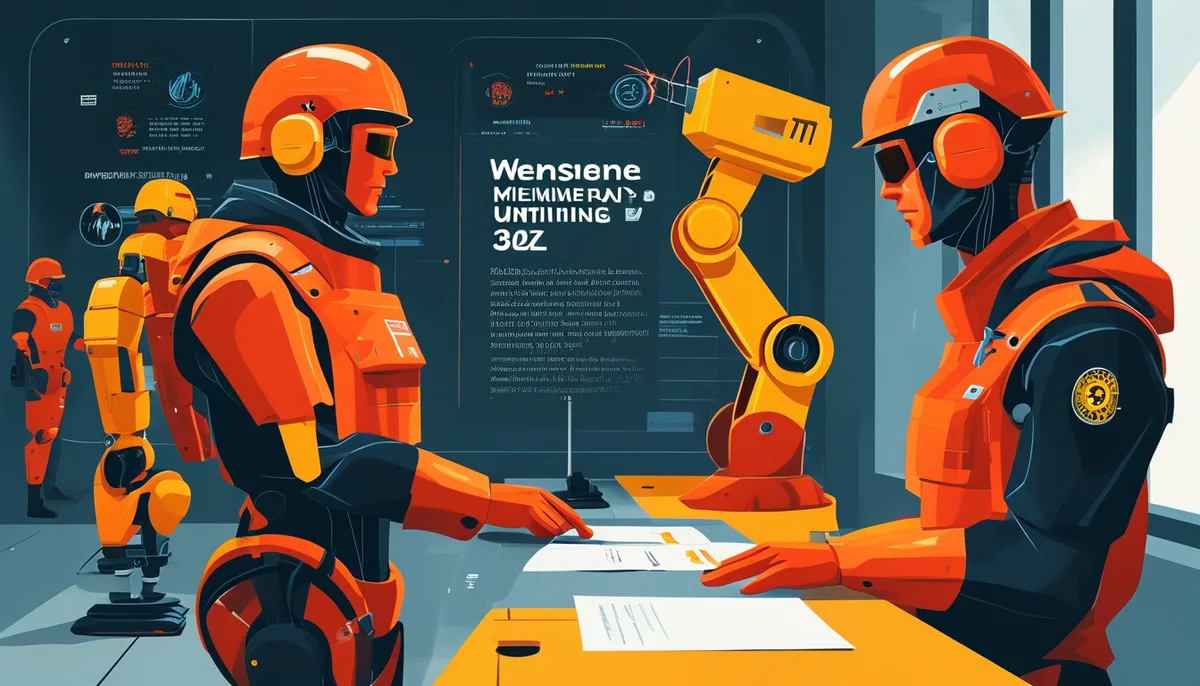
The German military is evaluating 30 artificial intelligence tools meant to speed up battlefield decision-making, with a working prototype targeted for the second quarter of 2027 and full rollout expected in 2028. That timeline and tool count come from Vice Admiral Thomas Daum, chief of the military's cyber command, who spoke to business daily Handelsblatt, according to Global Banking & Finance Review.
Most of the 30 systems under review come from German companies. French firm ChapsVision is one of the few non-German entrants, per the same reporting. Notably absent from the shortlist is Maven Smart System, the Palantir-built tool already used by the U.S. military, NATO commands, and several allies to analyze drone and satellite footage.
I spent twelve years watching schools adopt technology on timelines nobody outside the purchasing office believed. A vendor's demo and a classroom's Tuesday are different universes. The same gap applies here, at a much higher stake: an evaluation process is not a deployment, and 2027 is a target date attached to a prototype, not a fielded system.
What does "evaluating 30 AI tools" actually mean?
It means the German military has not chosen a system. It is running a comparison process across roughly 30 candidate tools, mostly domestic, to find one or more that can process battlefield data fast enough for real decisions. Gamereactor UK reports the same figures and frames the driver plainly: drone warfare and satellite surveillance now generate more data than human analysts can process in useful time.
That is a testable claim about volume, not a claim about which algorithm wins. Anyone who has piloted software for an institution knows the gap between "30 tools under review" and "one tool in daily use" is where budgets, integration headaches, and unglamorous procurement law actually live. A 2027 prototype target and 2028 full implementation are Daum's own stated goals, not guarantees. For related coverage, see What ChatGPT, Claude, and Gemini actually remember about you, per their own documentation.
Why did Germany rule out the best-known option?
Daum ruled out purchasing Maven Smart System in April, according to Global Banking & Finance Review's account of the Handelsblatt reporting. Maven is already used by the U.S., NATO commands, and several allies to analyze images and video for situational awareness, per the same source. It is arguably the most proven tool in the category. Germany passed on it anyway.
The stated reason is dependence and data sovereignty, not capability. Concerns over relying on U.S. software have grown "at a time when the U.S. is seen as a potentially unreliable ally after President Donald Trump repeatedly threatened to quit NATO," the reporting states. That is a geopolitical judgment sitting on top of a technical one — the equivalent of a school district rejecting a perfectly good platform because the vendor's parent company sits in a jurisdiction the district doesn't trust with its data.
What does the Ukraine connection actually establish?
The sourced reporting ties this evaluation to lessons from Ukraine, where drones and satellites have made the battlefield more visible than ever, producing data streams that exceed what human analysts can process. That is the stated rationale for wanting AI in the decision loop at all. The sources do not specify what data, sample, or testing protocol underlies that claim beyond the general observation about data volume — it is presented as strategic reasoning, not as a benchmarked result.
What should a skeptical reader watch for next?
Three things worth tracking, all directly tied to what the sources actually said:
- Whether a prototype materializes in Q2 2027, as Daum stated, or slips — evaluation timelines in large procurement processes commonly move.
- Which of the roughly 30 tools survive the evaluation, and whether German firms dominate the final shortlist as they do the current one.
- Whether the Maven exclusion holds through 2027, or whether pressure to interoperate with NATO allies already running Maven forces a reversal.
None of that is settled by the current reporting. What is documented is a number of candidate tools, a named official's optimistic prototype date, and one specific system deliberately excluded on sovereignty grounds rather than technical grounds.
The workload question nobody in the coverage answers yet
Every teacher who has adopted a new grading tool knows the pattern: the pitch is speed, the reality is a new category of verification labor. Military analysts reviewing AI-flagged battlefield data will face the same trade — faster synthesis, but a new job of checking what the model got wrong before anyone acts on it. Neither source addresses that operational layer, because the story right now is procurement, not use. That is a gap worth naming rather than papering over. For readers tracking how organizations vet AI systems before deployment, the underlying discipline — checking claims before trusting output — is the same one covered in a verification workflow for AI outputs that tiers the claims, then checks the load-bearing ones, and the same evaluation logic that governs any organization's workflow decisions around new tools. This connects to our earlier piece, A verification workflow for AI outputs: tier the claims, then check the load-bearing ones.