
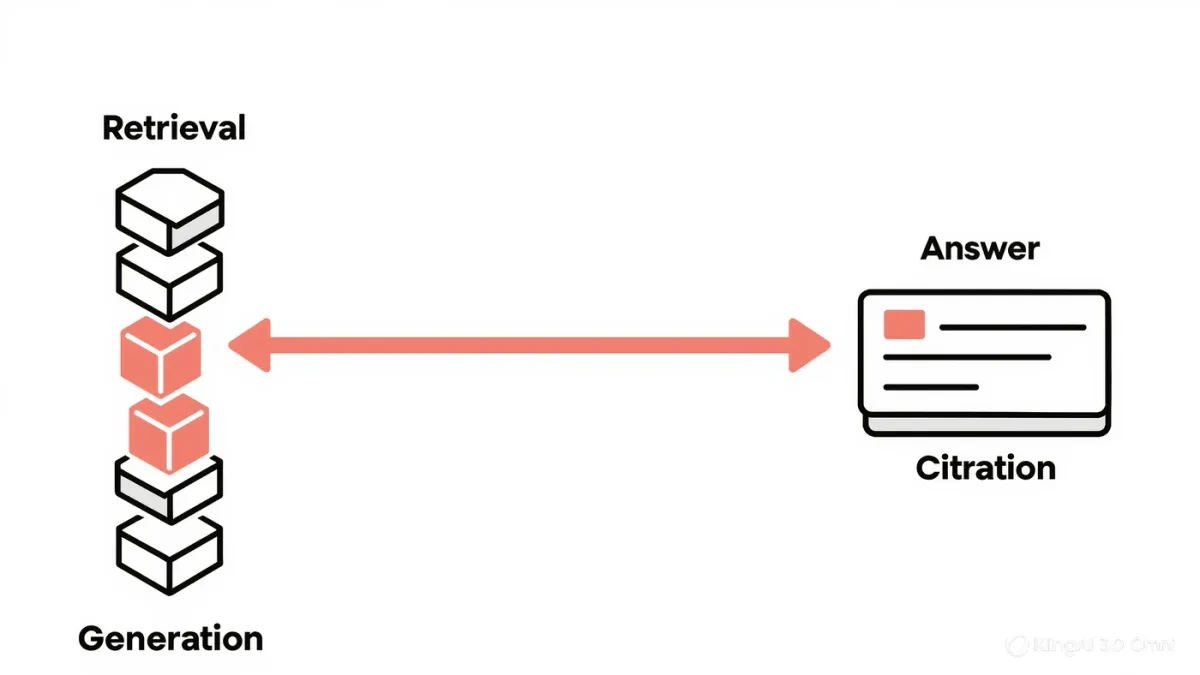
Retrieval-augmented generation (RAG) is a two-step pattern: when you ask a question, the system first retrieves the relevant passages from your documents, then has the language model compose its answer from those passages — and this architecture, documented in the research literature since 2020 and now the engine inside everything from NotebookLM to enterprise search to chatbots with file uploads, is why grounded answers can cite your sources: the model isn't remembering, it's reading. Understanding the two steps is genuinely useful, because it predicts the failure modes you'll meet: retrieval misses (the right passage wasn't found) look like the model ignoring your document, and generation drift (the answer departs from the retrieved text) looks like the model lying with confidence. Different steps, different fixes.
RechargeMe publishes information, not advice, and builds nothing here. The mechanics below follow the published RAG literature and vendors' documented behavior of consumer and enterprise document-Q&A products as of early 2026.
How does RAG actually work?
Offline: your documents are split into chunks, and each chunk is converted to an embedding — a numeric representation of its meaning — stored in a vector database. Online: your question is embedded the same way, the database returns the chunks closest in meaning, and those chunks go into the model's context as the material to answer from. That's the whole machine. The consequence worth internalizing: the model sees only what retrieval handed it. If the passage that answers your question wasn't retrieved — wrong chunking, unusual phrasing, meaning encoded badly — the model answers from the wrong material or from nothing, and the failure is invisible unless you check citations. The research literature treats retrieval quality as the dominant factor in end-to-end RAG quality; that single fact explains most home-user experiences with these tools.
What are the no-infrastructure options?
Documented, roughly in order of setup cost. Chatbots with file upload: paste or attach a document, ask questions — context-based, works per document or a small set, no chunking control, gone when the chat closes. Notebook-style tools: the source-grounded notebooks described earlier — persistent corpora, per-notebook limits, citations per answer. Note apps' AI assistants: Q&A over your existing notes, per their vendors' documentation. Enterprise RAG platforms: connectors to drives and wikis, permissions-aware retrieval, admin controls — the organizational version, with organizational pricing. And self-built: open-source vector stores, embedding models, and frameworks, for when the requirements (privacy, scale, custom logic) justify the maintenance. Most readers want the second or third; the fifth is a hobby or a job.
| Option | Setup | Best for | Weak point |
|---|---|---|---|
| Chat + file upload | None | One-off documents | No persistence, small sets |
| Source-grounded notebooks | Minutes | Recurring document work | Source limits, retrieval opacity |
| Note-app AI | Existing | Personal knowledge base | Terms for your notes |
| Enterprise RAG | Organizational | Permissions-aware search | Cost, vendor lock |
| Self-built | Days-weeks | Custom requirements | You own the ops |
How do you make home RAG reliable?
Documented habits that push failure rates down. Ask retrieval-shaped questions: specific phrasing close to the document's own vocabulary retrieves better than abstract paraphrase — "what does the contract say about termination notice" beats "can I get out of this." Demand citations and click them: the cited passage is your only window into whether retrieval worked; an answer without a citation is a guess wearing structure. Split unwieldy corpora: multi-document questions across dozens of files exceed casual tools' retrieval; narrower notebooks or per-topic corpora retrieve better. And keep the enumeration rule from earlier practice: "list every X" queries depend on retrieval finding every instance — run them in passes and verify counts against the document's own search. Every one of these habits exists because retrieval, not generation, is the weak link.
What about privacy and confidentiality?
The RAG architecture doesn't change the data terms — it adds a step where documents are processed to embeddings, and vendors' policies govern that processing. The documented landscape: consumer tools process your uploads under consumer terms (the NotebookLM-style no-training posture is a notable exception, per its privacy notice); enterprise plans attach stronger no-processing commitments; and self-built keeps everything on infrastructure you control, which is the entire argument for its maintenance burden. The decision rule matches every AI tool question in this series: match the deployment to the sensitivity of the documents, and re-read terms when features change.
What won't RAG fix?
Garbage in: a corpus of stale drafts, contradictions, and unlabeled versions answers questions fluently and wrongly — the documented "garbage in" property of every retrieval system ever built. Cross-document synthesis at scale: finding the passage is solved; comparing a claim across forty documents is still labor the tools approximate. And judgment: RAG systems retrieve and compose; they don't evaluate whether the retrieved clause is the operative one. The tools are at their best exactly where a careful reader with a search box was always effective — just faster. Where careful reading was never optional, it remains non-optional.
FAQ
- What is RAG in simple terms? Find the right passages in your documents, then have the AI answer from those passages — retrieval first, generation second, citations as the bridge between them.
- Why does document Q&A ignore things I know are in the file? Usually a retrieval miss: the right passage wasn't found at question time. Rephrase closer to the document's wording, or split the corpus — the failure is in step one, not the model.
- Is my uploaded document private? It depends on the tool's terms — consumer policies vary, some products document no-training postures, enterprise plans add stronger terms, and self-built keeps everything local. Match deployment to sensitivity.