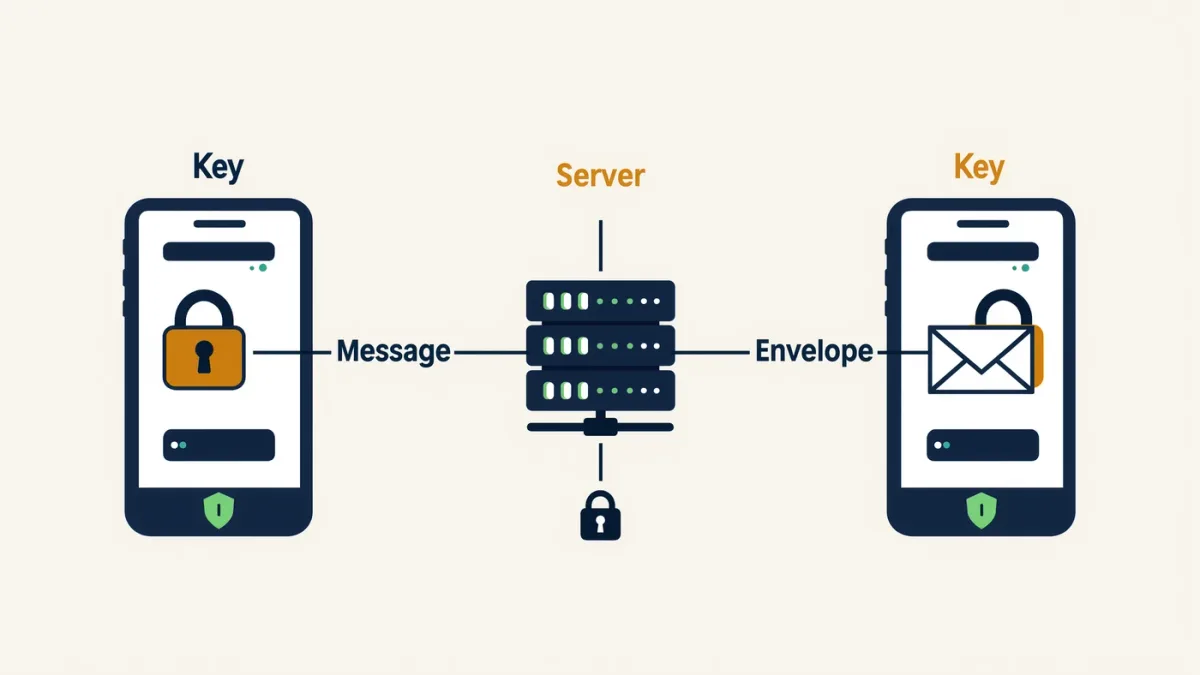
End-to-end encryption means a message is encrypted on your device, decrypted only on the recipient's device, and mathematically unreadable to everything in between — the messaging company's servers, network operators, and anyone tapping the wire — and the honest summary of what the technology does and doesn't cover is three documented limits: backups stored outside the encrypted channel, metadata (who, when, how often) which is not message content and is often visible, and the endpoints themselves, where screenshots, infected devices, and human error defeat the strongest cryptography. It is the strongest privacy primitive consumers routinely use, and it is not a cloak of invisibility.
RechargeMe publishes information, not security advice. The mechanics below follow published technical documentation from messaging providers and national cybersecurity authorities.
How does E2EE actually work?
Public-key cryptography, per the standard descriptions in providers' security documentation: each device generates a key pair — a private key that never leaves the device and a public key it shares freely. To write to you, a sender encrypts with your public key; only your private key unlocks it. The server relays an encrypted blob it cannot open; keys change between sessions in the best implementations — forward secrecy — so a compromised key doesn't unlock past traffic. This is the documented design of major messaging apps' encryption layers, and the reason a provider can honestly say it cannot read your messages: mathematically, with well-implemented E2EE, it can't.
What are the documented limits?
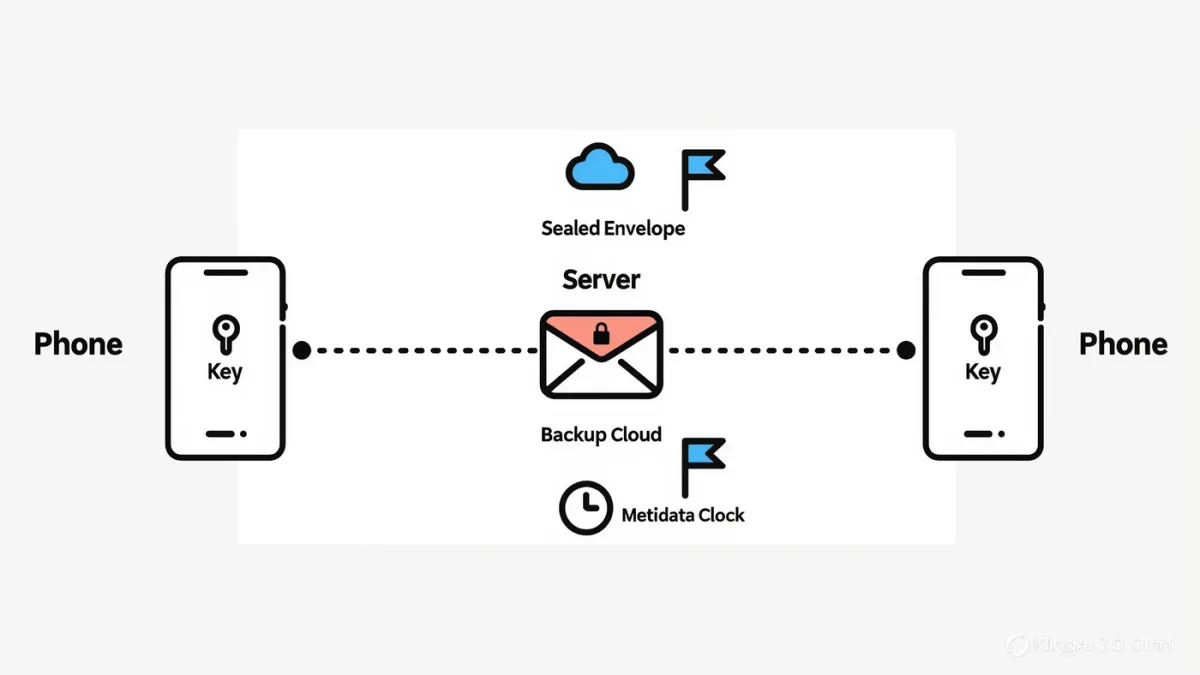
Backups first, because they are the most common silent hole: an encrypted message decrypted on your phone, backed up to a cloud service unencrypted, is protected in transit and exposed in storage — precisely the gap several messaging providers closed by adding optional encrypted backups, per their feature announcements, and the gap law-enforcement disputes have publicly centered on. Metadata second: E2EE hides content, not the envelope — who you messaged, when, how often, from where is typically visible to the platform and is, intelligence agencies' own published statements note, often as revealing as content. Endpoints third: a phone with malware, a partner who screenshots, a device left unlocked — the strongest pipe delivers plaintext to a compromised destination.
| Protected by E2EE | Not protected |
|---|---|
| Message content in transit | Cloud backups (unless separately encrypted) |
| Content on the provider's servers | Metadata: who, when, frequency |
| Past sessions (with forward secrecy) | Compromised endpoints and screenshots |
| Wiretaps between devices | Social engineering and device seizure |
How do you know a chat is actually end-to-end encrypted?
Don't trust the word — check the mechanism, per providers' own security pages. The documented pattern: an option to verify security codes or safety numbers — fingerprints of both devices' keys that you can compare out-of-band (in person, by call) to confirm no machine-in-the-middle. Apps that offer no verification path and no security documentation are asking for trust rather than offering verification; the difference is the product. Default-on versus opt-in also matters: implementations documented as E2EE by default for all chats protect everyone, while per-chat toggles leave the default conversation exposed.
Where does E2EE meet AI tools?
At the boundary of the new assistants: most AI chat products are not E2EE by design — the vendor's servers process your prompts to generate answers, which is a different architecture with different trust terms, per those vendors' own documentation. That is not hypocrisy; it is structural — the service must read your input to respond. The user-side consequence is the one worth internalizing: the privacy guarantees of your messaging app do not transfer when you paste the same content into an assistant, and the relevant protections there are data-use terms, retention windows, and tier-level no-training commitments — contractual and policy controls, not cryptographic ones.
What about the policy fight?
E2EE sits in a documented, ongoing policy dispute: governments have repeatedly proposed mandated exceptional access — the UK's Online Safety Act debates and successor proposals, and analogous arguments elsewhere — while technologists and security agencies, including assessments published by bodies such as the US Cybersecurity and Infrastructure Security Agency and the broader security community, have warned that weakening encryption for anyone weakens it for everyone, since a backdoor is a vulnerability by definition. Coverage of this fight at major outlets treats both claims seriously; the technical consensus against exceptional access is broad and public. The policy outcome is undecided; the math is not.
FAQ
- Is E2EE unbreakable? The cryptography, well-implemented, is not the weak point — attacks documented in practice go around it: unencrypted backups, metadata analysis, endpoint malware, and human engineering.
- Does E2EE protect me from the app company? For message content, yes, by design. For metadata, backups you enable, and everything you do on a compromised device, no — check each layer.
- Are AI chats end-to-end encrypted? No, structurally — the service must read your prompt to answer it. Your protections there are the vendor's data-use terms, not cryptography.